
-
Call Us
(+91) 910 694 9006 / 0937 584 6937
-
Email Us
- Get A Quote
The compression springs are winded over a rod or fitted inside a hole. When a load is applied, the spring gets compressed and pushes back to regain its original shape. These springs offer resistance to linear compressing forces.
The compression springs are the open-coil helical spring that resists any compression force applied on it axially. Compression springs are usually coiled at a constant diameter, they can also be coiled in other shapes like – conical, barrel, hourglass, or a combination of these shapes.
ConfigurationsThe straight springs are the most common compression springs. Mostly, the spring diameter remains constant for the whole length. The straight coil configuration is the standard coil type for stock compression spring types. The compression springs are of the following types - concave, conical, and convex type springs.
The maximum deflection can be achieved without causing any damage to the spring when the spring is not subjected to shock loads, rapid cycling, temperature extremes, corrosion, or stress value above the recommended levels. Extended service life is attainable when the spring is statically loaded.
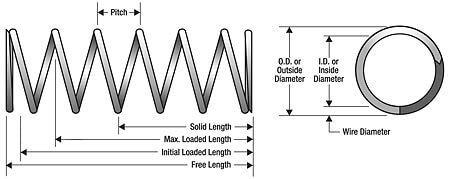
Key ParametersThe key parameters to take note are – inner diameter, outer diameter, wire diameter, free length, and solid height.
The free length of the compression spring is the overall length of the spring when the spring is in the unloaded position.
The solid height of the compression spring is when sufficient load is applied to the spring and all its coils are compressed to the maximum in a way that the adjacent coils touch each other. In this condition, the length of the compression spring is known as its solid height.